
ARIPO

African Regional Intellectual Property Organisation

The African Regional Intellectual Property Organization (ARIPO) is an intergovernmental organisation that administers intellectual property rights on behalf of its member states. Established under the Lusaka Agreement in 1976, ARIPO provides regional application systems for patents, utility models, industrial designs and trade marks, allowing applicants to seek protection in multiple participating countries through a central office. The countries covered depend on the protocol governing the particular intellectual property right.

Requires the applicant to designate member states where protection is required.

ARIPO (African Regional Intellectual Property Organisation) is an organisation that facilitates registration and administration of intellectual property rights for various African countries. Membership of the organisation is open to all Member States of the African Union (AU) or of the United Nations Economic Commission for Africa (ECA). As of 31 December 2020, the organisation comprises of 21 member states.

The organisation registry is located in Harare, Zimbabwe. ARIPO is mandated to grant patents on behalf of the Harare Protocol contracting states in accordance with the provisions of the Harare Protocol on patents, designs and utility models. The organisation is mandated to register marks and the administration of such registered marks on behalf of the Banjul Protocol Contracting States in accordance with the provisions of the Banjul Protocol on Marks.

Trade Marks

The relevant protocol on trade marks for ARIPO is the Banjul Protocol. The protocol authorises ARIPO to register trade marks on behalf of the Banjul Protocol Contracting States. The Banjul Protocol establishes a trade mark application filing system along the lines of the Harare Protocol. An applicant may file a single application designating the specific contracting states either directly at the organisation or through a contracting state.

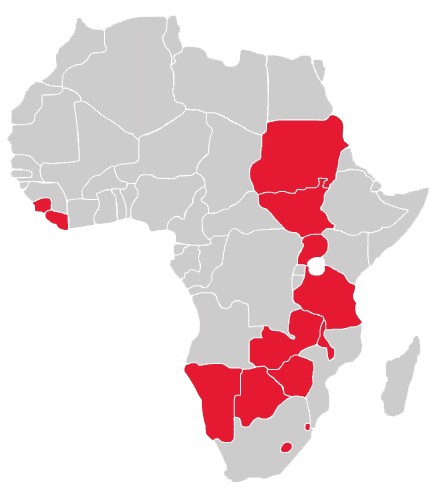
States currently party to the Banjul Protocol are: Botswana, Eswatini, Lesotho, Liberia, Malawi, Mozambique, Namibia, São Tomé and Príncipe, Tanzania, Uganda and Zimbabwe. It is important to note however, that not all the countries have incorporated the provisions of the Banjul Protocol into their national laws, effectively questioning the enforceability of ARIPO trade mark registrations in certain contracting states.

Patents

The relevant protocol on patents and designs for ARIPO is the Harare Protocol. The organisation is also a member of the Paris Convention and of the PCT. The Harare protocol authorises ARIPO to register patents and designs on behalf of the contracting states. ARIPO Applications specifically require the applicant to designate those member states where protection is required.

Currently the states which have acceded to the Harare Protocol and who may therefore be designated in a patent or design application are:

Botswana, Eswatini, Gambia, Ghana, Kenya, Lesotho, Liberia, Malawi, Mozambique, Namibia, Rwanda, São Tomé and Príncipe, Seychelles, Sierra Leone, Sudan, Tanzania (mainland), Uganda, Zambia and Zimbabwe. 
What We Do

Our ARIPO services can assist businesses, inventors and creators with intellectual property protection in participating African countries.

✓ ARIPO trade mark registration

✓ ARIPO Patent applications

✓ Utility model registration

✓ Industrial design registration

✓ Trade mark searches and assessments

✓ Patent searches and patentability assessments

✓ International filing strategies

The Process

The registration process depends on the intellectual property right being pursued and the countries in which protection is required.

The first step is to identify the relevant right, conduct appropriate searches and select the participating countries to designate. The application and supporting documents are then prepared and submitted to ARIPO or, where permitted, through the relevant national intellectual property office.

For patents, this includes the applicable search and examination process.

For trade marks and industrial designs, designated states may examine the application or raise objections under the applicable rules.

An applicant may file a single application designating the specific contracting states either directly at the organisation or through a contracting state.

Requirements

The documents required depend on the type of application.

Applicants who do not reside or have their principal place of business in a relevant contracting state may be required to appoint an authorised representative.

The precise requirements depend on the applicable protocol and the applicant’s circumstances.

Renewals

The patent and utility model terms are specified in ARIPO’s published filing guidance. Trade mark registrations are renewable in successive 10-year periods. For industrial designs, plant varieties and other rights, the applicable protocol and current regulations should be checked before stating a specific expiry date in a client agreement or registration schedule.

Transfer of Onwership

Intellectual property rights registered through ARIPO may be assigned or licensed, subject to the applicable protocol and relevant national requirements. An assignment transfers ownership of a right from one party to another. A licence permits another party to use the right under agreed conditions while ownership remains with the rights holder. Transfers may take place through a sale, an assignment agreement, a business acquisition or another legally recognised transaction. Licensing agreements may specify the permitted uses, countries, duration, royalties and other conditions.